
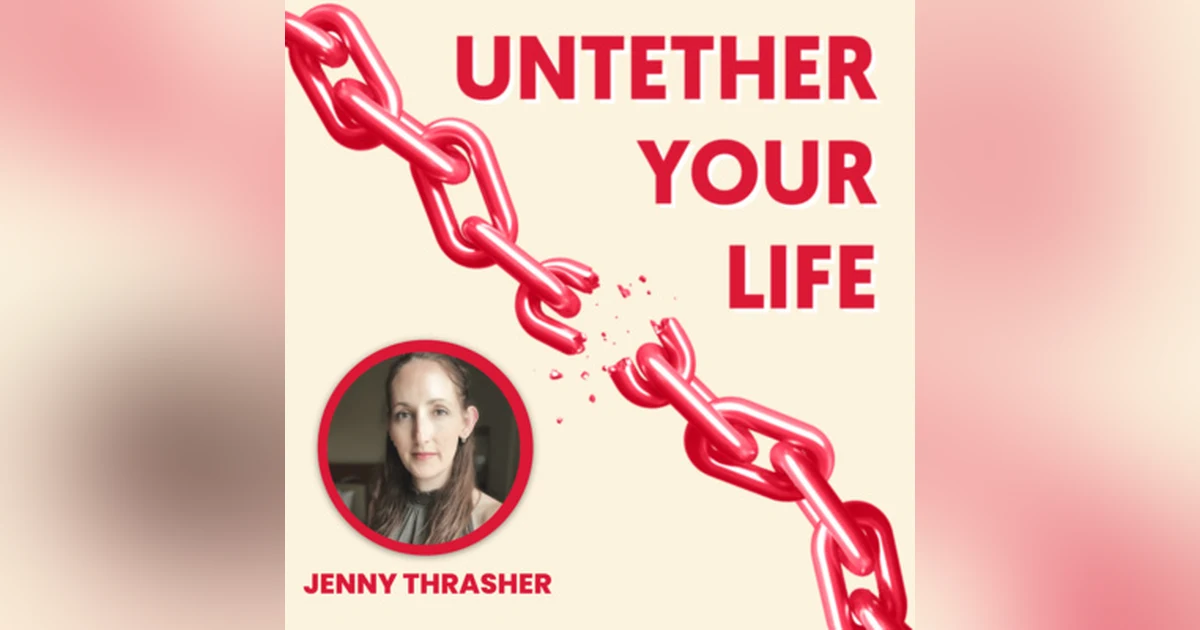
54: Jenny Thrasher, All That We Are - Beyond Saving a Life, to Living a Life We Love


 Apple Podcasts

 Spotify
Jenny Thrasher is on a mission to "shift the mental health narrative from a fear-based, crisis mentality to one of wellness and empowerment." Through her companies All That We Are and Growing Out of Darkness, as well as her writings, she was able to untether herself from the traditionally dire and hopeless approach to navigating the gut-wrenching journey of loss. This is a topic the tireless mental health advocate is all too familiar with, as her father died by suicide, her own daughter nearly took her life, and she herself struggled with suicidal ideation following pregnancy.
In this episode of Untether Your Life, host Nikhil Torsekar and Jenny touch on many topics, including:
The vital importance of practicing safe messaging and exercising caution with our choices of words when discussing difficult concepts such as suicide How the tragic loss or near loss of a loved one can teach us to shift from simply staying alive to truly living a life we love The actual stigma around suicide (most likely different from what you'd think) The background and mission of All That We Are and Growing Out of Darkness The story behind her published book Growing Through Grief, as well as her upcoming work The merits of acupuncture, reiki, reflexology, emotional freedom technique (EFT) and other holistic healing modalities
To learn more about Jenny and request a copy of her book, please visit All That We Are or Growing Out of Darkness, or connect with her on Instagram at jennythrasher.allthatweare.
Connect with Nikhil to learn more about Untether Your Life and other projects:
0:01 When discussing difficult topics such as suicide, why is it so vitally important to practice safe messaging and be extremely careful with our choices of words. How can the tragic loss or near loss of a loved one? Teach us to shift from Simply Staying Alive. To truly, living a life that we love. What is the actual stigma around suicide? The answer may surprise you. And what is the background in the mission of all that we are, how is the company and its founder quote Shifting, the mental health narrative from a fear-based And crisis mentality to one of wellness and empowerment stay tuned. As we touch on these and many other topics on this week's episode of untether your life.
0:47 Welcome to untether. Your life show that empowers you to own your own health and break free of templates for managing physical and mental wellness. And looks at Key issues, impacting the South Asian diaspora. I am your host to kill towards car and I am Passionate about the power of conversation to catalyze. Change this week, we speak with Jenny Thrasher, International keynote speaker, founder of all that we are and author of the book. Growing through grief while Jenny has a degree in Psychology, she attributes her Authority on the subject matter to her life experiences as well as her determination to truly understand and effectively respond to the challenges she and those around her effaced. Losing her dad to Suicide, drove her to understand mental health. Facing her own health challenges taught her about Wellness, but it was almost losing her daughter to a mental health crisis. That helped her to understand that. It isn't enough to Simply Save a Life. We have to learn how to live a life that we love and with that, let's get untethered.
1:42 So Johnny thanks so much for joining us. I was willing to kill. It's great to be here. Can you tell us a little bit more? Maybe about yourself Beyond with the information that I just share? Yeah. So for me, People always ask, how did you get into this? And isn't it depressing to do this work every day? And, you know, as you shared it with reading my bio, I got into this because I lost my dad is suicide. So I was 20 years old, getting my degree in Psychology when he passed away, and after I went death through that initial shut down and deep grief. When I was able to return to school, I needed understand why? Because the stigma around suicide, wasn't a reflection of who my dad was.
2:23 And I really needed to understand what happened to him and I also needed them to understand that I wasn't. Okay. And so I was surrounded by just an incredible staff of teachers and fellow students who not only supported me and my journey and healing but they also challenged me and my way of thinking and the way that I was approaching mental health and wellness, you know, it's been over 20 years since I lost my dad. I don't find this depressing. In fact, I always say to people talking about mental health doesn't have to be depressing. I An easily flow from talking about something really heavy and intense to laughing about things. But a lot of that is because I see every interaction with someone as an opportunity to further my healing as well as help them in their own healing journey. I don't remember the exact quote but I think I think is Viktor Frankl.
3:12 He says suffering ceases to be suffering, once it has meaning and that's so it sounds like you've definitely been able to transform pain into purpose and passion. Could you tell me a little bit? More about some of the organizations that you founded. Okay. I guess is around 2015. It was about fifteen years. After my dad had passed away. A friend of mine had reached out to me to let me know that two of her friends had each lost, a loved one to suicide and she knew everything I've been through not only losing my dad but also going through postpartum depression, becoming suicidal being a crisis counselor and a public educator on suicide prevention. And so she asked me if I would write Write her friends, a letter letting them know that healing was possible.
3:56 And after a couple of weeks I reached out to her and I said, you know, I haven't forgotten you, I'm working on this, I just don't know where to stop. So I then sent her what I've been working on and she called me back and she said, don't stop, you have to keep writing, you have a message that needs to be heard. So she asked if she could send part of my what I've been working on to her friends and I said yes. But then for three years, I continued to write whenever I would feel compelled to do so And it was in January of 2017. When I realized that all of this that I've been working on was a book and it was actually going to be published and immediately. I felt this paying of, I don't want to profit off of this and I know what it feels like to be in pain and to feel alone. And so I started growing out of darkness, which is a nonprofit that is focused on providing support and dividuals who've lost a lot.
4:53 Luna suicide. And the way that we primarily Provide support is by donating copies of growing through grief to anyone who requests one. That's the name of the book. Yeah. Let me ask you Jenny. Is it available in bookstores or anything? Because I wasn't using available on Amazon so you can get it there. But you can also go to growing out of darkness, dot-org and request a copy. And I will get a copy out in the mail to you. No charge, no charge. Strength, that's incredible. Because I think it is true that there are people even with all the information that were inundated with, there are so many people out there suffering in silence who think because it's like, you know, you have, you might have that friend or you, there might be that celebrity, who's going through something similar. But it's such a personal thing and, you know, to have a resource like that in the fact that you send it out, free of charges, to put it in your needs it. I think that can be extremely uplifting. So you admit Mention that with suicide, you have really seen all angles of this whole none drum, which is just that, obviously you said your father had died by Suicide and then, you know, your daughter had also struggled with it and then did you say that you had also had some ideation through postpartum?
6:11 I did now, let me ask you, is it something with your organization's? It's such a big problem that you're trying to tackle. Is there any one specific facet of this suicidal? You had that you tend to cover like do you tackle it in terms of like workshops or other resources? Yes. So, you know for me as you just mentioned languages is fundamental I am intentional in removing the sigma and and so when I go in and I do workshops and trainings and and I'm teaching people how to talk about it and really, it's about removing the fear and replacing that with understanding and compassion. So people know how to respond versus React part of that is changing the way we talked about it and the way we think about it.
6:59 And so we need to do that by first addressing, what is the stigma? And you know, most time when I go in and I talk to groups and I'll and I'll ask what's the stigma around mental health around suicide. And the number one answer, I receive a shame but that's not the stigma. That's the result of the stigma, the actual stigma associated with mental health and Suicide, is that this person is feeling, sorry for themselves that they are choosing to be this way that they are. Just trying to seek Vengeance on people around them, you know, and hurt others. Or that, they are being seen as broken and either needing to be fixed or incapable of being fixed. And so, what I do is I try to teach a language that really focuses on the individual as a human while recognizing that they're facing challenges.
7:53 Has, which is why, you know, you'll hear a lot of Advocates, use terminology that I do not use such as that. Some people might say that my dad killed himself, but you will never hear me say that. Because for me to say that or to say that he took his own life would insinuate that he made the choice. And what I know is that had my dad been healthy, that would have even been a choice. Like, he wouldn't have even been considering it. And so what I try to help people understand is that when someone is at that point of being suicidal their ability to Make rational decisions has been compromised, you'll hear me say I lost my dad to Suicide or he died from suicide. So, definitely addressing language, addressing stigma is fundamental but in addition to, that is even safe messaging and what we mean by that and some people again will say well if you're trying to teach me safe messaging is because you're trying to censor what I have to say because I should feel ashamed of what I'm going through.
8:47 That's not what safe messaging is about. Safe messaging is recognizing that we don't know who's in. In our audience. So we want to use minimal graphic details. When you say safe messaging, I want to make sure I understand this. You're talking about the person who is actually struggling with the suicidal ideation and things like that, right? Not so much, the person who's talking about so it's okay, someone talking about someone they lost it could be someone talking about their own attempt, it could be someone talking about what they saw on a TV show or a movie or read in a book and it's not Us when it comes to Suicide, we're talking about any kind of traumatic event is to be aware that we do not know who our audience is. We do not know what they've been through and more importantly, we do not know what support system, they have in place. So, one of the things that we always want to ask ourselves as speakers and even Beyond speakers, but just humans, who might be out having coffee, or having lunch or dinner with someone and recognize our voices carry, the people sitting around us.
9:53 Certain words are going to catch our attention. You know, that we want to be aware of how we are talking about things with a recognition of asking ourselves. What? Purpose of this serve are these details necessary. Is it really to amplify the story and sensationalize it? Or is it serving a purpose? Do I need to know that specific detail and one way that I share this is that there was a man that I met in 2016, right before, I knew that my book was going to be published. In fact, he was part of what helped me to make that Discovery. So he and I were flying on a plane back to Minnesota and I never met him before. He's asking me questions about me and what I do.
10:35 And I told him that I was working on this book and I told him was about, it was about losing my dad, and my healing journey and he asked me if he could read it. And I said no, like no, no, no, we can read this, like I'm not ready, I'm not ready for that and then he gave me his card and it turned out Now that he was actually an advocate for suicide prevention. And you guys, you guys just randomly start playing the seems to happen to me quite a bit, actually. Yeah, I think that I'll meet my next Greatest Love on an airplane because that's really weird where the universe puts people like this in our path. Yeah. So he even said to me, he asked me, can I tell you my story, right?
11:18 So, he was a suicide attempt Survivor. And I said, yes, of course, he then, Shared his story with me and graphic detail. And at the end of his story, I'm in tears and he says to me now, can I read your book? And I said, yes, but not just because you attempted suicide and survived, but because you attempted in a way that it is a miracle, that you're alive, and even more. So because you attempted on August 12 1978 which was the day I was born. Oh, wow. Wow, okay, yeah, that's wild. Yeah, that's not a signal from the Universe, I don't know what it is.
11:59 Right? Right. So yeah, so I sent him. My book less than 24 hours later, he called me back. And he said, Jenny, you can't keep this to yourself. You have to share this with the world. And so I'm sharing this story with you, because if I had told you his story in graphic detail, what purpose would that have served. So but the point was the connection between us, right. But there's a lot of people who will get Shut up in the like I need to tell you every detail. So you understand how bad it was the problem with that? Not only are you potentially causing pain for people around you that you don't even realize it, but you're reliving it. And every time you relive, it, it is putting you in a compromised position to be in that depth of pain. Again, our mind actually doesn't know the difference between living it right now and reliving it from a past experience. When we tell it in graphic detail, So, we want to be very cautious of how we're sharing our story. And again, it doesn't matter if it was a suicide attempt. If it is an assault of some kind, one of the things that I try to teach people a safe messaging is, are you aware of your own state of well-being?
13:06 Are you approaching this with the idea of being able to share with people what you learned from it? Not just the experience just like throw them? How did you grow and you're touching on the what which I think is really important. But then there's also the how and Love to hear your thoughts about with social media. I mean, I think it's a mixed blessing because obviously it gives a channel for people to engage. For me, personally, with Instagram or Twitter, it's exposed me to a lot of people because as you and I have discussed and I suffer from bipolar disorder and I found an amazing Community out there. Whether it's through Twitter spaces, or Instagram lives, or even this podcast. But then, the flip side of that, is, it can quickly devolve into what I call hyper pathologizing. I don't want to trivialize or diminish anyone who's going through this, but it is easy to slip into. That almost wallowing, you know, where it's something you're talking about.
13:59 The problem with out that path to resolution, or that path. You're never going to solve the problem, but at least find a way to as you alluded to live through it. You know, not just get over it, tell me more about your thoughts about social media and how it's impacting the journey with people either who are suffering through the suicidal Journey, but also people their loved ones and others around them. It is Sweet on one hand. It provides you this ability to connect with other people and feel like you're part of a community. On the other hand I think it can be very unhealthy when I wrote about that in my book. I personally, I can't spend time on social media and it's hard because it's like, I'm supposed to be posting to social media and sharing this message, but and I do I try to put stuff out there and I try to put real self not just like look at me and look how great my life is. But I will also say yeah, this is hard for me right now. My focus is on how I'm Growing, but if I'm being honest, this kicked my ass, but yeah, you know, I try to be very real and the fact is that I think that there are a lot of Advocates, are a lot of people out there who are in positions of authority, whether it's because they're leading a business, a church, maybe they're a leader in the military or first responder who don't feel that they can be real about what they're experiencing and they keep that to themselves. I do know that some hospitals have created like anonymous Type support groups and connections for their doctors, to be able to reach out for help, but it is a challenge. And for me, you know, again, not
15:31 just within the world of mental health, but I have a daughter who was born with a rare condition. I remember in the, you know, like the first ten years of her life, I like I would meet one or two people and those 10 years that knew what this condition was and we were fortunate to be connected to one of the leading specialist in Boston. And that he took on her case and so whenever we needed help, we would contact them. But she was probably like, said 10 or 12 years old. When I discovered that a Facebook group had started that was specifically about her condition. And I was so excited because I was like, oh my God, I'm gonna connect with other people and when was this, this would have been in like 2012 because this after we moved to Memphis. And so, I found this group and I was really excited until I started realizing that most People that were posting stuff on there.
16:25 We're posting misinformation. And so I found myself trying to let people know, like, oh no, like actually are specialists in. Boston, is saying you want to try to avoid antibiotics or, you know, like, there's these different things that I'm trying to share, and I was such a quiet voice in that group, and I found it so, overwhelming, and heartbreaking. Like when I have a hard time with the work that I do. It's not, because I'm engaging with someone who's going through a difficult. Time and they're sharing it with me. It's because I'm on social media seeing quote-unquote experts and authorities in the field whether it's lymphatic malformation or mental health that are putting information out there that I think is actually more harmful than good.
17:09 That is what I struggle with. Like that's that is what's hardest for me. And I am, I thought is oh my gosh, if this is the best that these people think they're ever going to experience, or this is the best advice they're ever going to actually take. N and process my heart is breaking for them. You know. And for instance I've gone to several events where it's for suicide for survivors of suicide loss and those meetings will start by the person saying well, as you know, you know, suicide is the most painful experience over go through and it's something that you'll never get over. And I'm and I'm just going, it's not a good message. No, I'm it's like, you know, I'm being punched in the gut when someone says I and I'm I'm looking around the room at all of these people and I have very high empathy.
17:58 Yeah, not only. Am I looking around, I am Fairfield anguish the Despair and and I'm just going. What did you just say? Like, I don't know if these people lost someone ten years ago or ten days ago, but you just basically told them they're never going to get better. And what I try to say is, what you mentioned earlier is, I like to say, it's not about getting over it, it's about growing through it. And for me, for example, it took me several, Years. But with my dad's death, it is one of the most painful experiences I've ever been through. And yet, I can also tell you that it is been one of the greatest blessings of my life because my dad's death saved my life and I recognize that again, it was, you know, probably 15 years after he died.
18:42 But it was this awareness that his death is what introduced me to holistic healing. I began to worry. I did want to touch on that, I wanted to preface that and say that with mental health in the This country. I think, you know, I've talked to people in different countries and I wouldn't say where the leader of the pack, we have a long ways to go. We're better than other countries, but by and large, I think what is frustrating is just that there is this very one-dimensional view of mental health, is that just using the qualifier mental? When you talk about health, I think is very misleading, and very disingenuous because it introduces this false compartmentalization about, you know, this is the It's all in your head you know septic tank in an apartment building it's not like if something happens to it so I'm going to affect you at wonder you know it's a whole ecosystem, your whole body.
19:32 So I find it refreshing when I encounter mental health professionals like yourself who are looking beyond the because that's one of the themes of our podcast is owning your own health, you know, just going beyond the traditional modalities of surgery medication, and obviously when it comes to mental health cognitive therapy. So I just wanted to say that, you know, I do appreciate the message. You're Being out there and he's not would like to turn it over to you and just tell me more about your journey with the mind-body connection and sort of how you've optimized that because I know you had gone through quite a few health challenges of your own physical as well. So if you can. Yeah, yeah. So, you know, even in the bayou, you mentioned that it was my dad's death, that helped me to understand mental health. It was then going through my own health challenges, it helped me to understand wellness and there's a difference. And then it was almost losing my daughter. That helped me to shift again from being focused on simply Staying Alive, to really truly living a life you love. And yeah.
20:32 And so it's been all of those experiences that helped me to recognize this holistic approach. Right? And and as I mentioned, my dad's death is what initially introduced me to it. So after he died, I began having panic attacks. My dad was my safe space growing up, and he meant everything to me. And when he died, I did not know how to function. I mean, I could barely breathe for anybody, the age of 20. I mean that's a very turbulent time by nature but to compile that with what you went through most of them. Yeah. Cannabis yeah. Yeah I know and this was the man who had one of my values for growing out of darkness is called be the village and it's inspired by my dad and what it means is that we have to surround ourselves with people who will push us past our comfort zone encourages during times of self-doubt, and loved us.
21:21 Even when we feel Unlovable and we have to be willing to do that for them as well. And my dad is really who instilled those beliefs and me. And so when he died like I said earlier, it just didn't make sense. This isn't who he was. And so, yeah, the panic attacks started, I had actually right before my dad died. I've been diagnosed with amyotrophic of prolapse, which is a heart condition. So when I started having panic attacks, I didn't know what it was and I was like, oh my gosh, it's this heart thing that they've just told me that I have. And but I was really fortunate because a classmate heard me talking about the challenges I was facing and she is who pushed me into doing acupuncture, what I ultimately discovered in getting acupuncture was that it not only alleviated my panic attacks, but it actually gave me a sense of calm that I had never experienced in my life.
22:16 And, and for years, I just relied on it without understanding it, without knowing anything about it. I just Go. He put the needles in me, you know, sometimes, he'd give me some herbs, but I just, I felt balanced. Yeah, I felt strong. And then, in the way that I say, that it saved my life was that roughly five years after my dad died, I had my first daughter and even though I was a crisis counselor and a public educator on suicide prevention, I miss all my own signs. I was going through postpartum depression. I thought well this is just what it is to be a new mom like I'm exhausted all the time. I feel guilty. Guilty all the time and I just felt this heaviness. It's interesting. How clinicians are usually the worst? As they say?
22:59 The doctors are the worst patients because it's almost like they're immersed in that 24/7. And then when they have to turn the front of themselves, they just missed the sign. But I also think that part of it is because of the way, it's been taught all these years. And instead of being taught to be aware of my well-being of what it feels like for me to be healthy. And to recognize when I'm Going to feel unhealthy that's not you know even for me as an educator on suicide prevention, that's not what I was teaching people. I was going out and following the script of like, this is what you look for. Well, when you talk about the signs and symptoms that someone might be going through depression or might be suicidal.
23:40 It's like, saying you might have covid if there's a hundred different things, you could be looking at. So it's not immediate. I mean right now because we're all recently, coming out of covid. That's everyone's first thought. Oh my God, I might have go. Bit. But if you're going through all these different symptoms and what not your first thought isn't like, oh this might be depression, this this might be that I'm actually suicidal, you know, first of all your mind isn't working correctly and so my husband came home and he found me sitting in the dark holding her daughter and he asked me what was going on without even knowing that. I was speaking. I just said, I'm scared, I'm going to die. And that moment, my dad's death saved my life because my husband had been there when my Died.
24:23 He recognized what I was saying? He understood it and he understood to take me serious. He also knew that what helped me after my dad, died was acupuncture and so in that moment he didn't even miss a beat and he said, let's get you back into acupuncture. The other thing he did for me, was he recognized? I was not okay. I was barely functioning the way I described it as like, I had two brains, I had my healthy brain that would say Jenny get out of bed. Go brush your teeth. Teeth, eat food. Take a shower. Then I had my unhealthy brain. That was constantly telling me how I could die. And eventually, what happened was my healthy brain became quieter and quieter.
25:06 And the only things that mattered to my healthy brain was take care of the baby. So even when my doctor had given me some medication at one point for a sinus infection and she said just put it right by your toothbrush. And when you brush your teeth in the morning, take this medication and I was like, oh my god, do you think I brush my teeth every day? I was barely functioning and so my suicidal brain was continuing to get louder and louder to the point that I was scared to go in the kitchen. I didn't want to be around knives. I was scared to drive my car because I was afraid that I would drive it off a bridge. I was scared to take a shower and that my Razor to shave my legs, that that everything to every represent a danger base, everything represented danger.
25:46 And what I was afraid of was myself. I mean, I was truly terrified of Elf and that I was not in control and that I could die any minute where you sort of, seeing the writing on the wall, where you think it because of what my father went through. Maybe this is sort of like, no. Oh, I didn't. I mean, I was really not well and I wasn't connecting the dots, and that's what I mean. Like, when I said to my husband, I'm scared. I'm going to die. That was the first time that I had verbalized, or even consciously been aware of what I was. Experiencing it just was almost like, this movie was playing in my head. That was non-stop. What are the things that I tell people is no one chooses to be this way?
26:28 No one chooses to be a fight at a certain point, though we have to fight for our life. We love. However, there are times when we're so bad, we don't know how I didn't know how, and I'm fortunate that my husband was able to step in and say, this is how I'm going to help you. I'm going to help pull you out of this hole that you're in. And that I didn't resist. I didn't fight him. I went along with him and I was Scared and I was a basket case, and most people had no idea. When my friends found out later that I've been going through this, they had no idea and it wasn't because I was trying to hide it. I wasn't conscious enough to be able to hide. It's almost like I would go into autopilot when I was around other people you bring up an interesting point because I think about celebrities these days, you know, when you talk about people like Anthony Bourdain or Kate Spade or and most recently it's a give specific Stephen boss twitch.
27:22 Because they on the outside, they appear to have it all, they appear to have it figured out there. So positive, they just Inspire so many people. And then, you know, one day they end up taking their own life. But it's very frustrating to me as someone who's very passionate about mental health advocacy, partly because of my lived experience, but also partly because I see that there's so much opportunity for change out there. It is frustrating, when mental health becomes the cause du jour, you know, after some precipitating event like this, there's a lot. Of awareness. You know, people are changing their profile pictures, there's hashtags Galore, and then, you know, nothing. But I think a lot of is because people don't know what to do. They honor it. They recognizably like, man, this just happened, that really sucked and my heart's breaking.
28:06 When I when my daughter actually called me and told me about twitch, we are huge. So You Think You Can Dance fans in this house and he is one of our all-time favorites and she called me and told me and I just cried I cried because this man, like, you didn't have to know him to feel his light and his love, and this energy that he brought into the world. And I had a lot of people reach out to me saying, how Jenny help me understand this, this is where I'm Different in the way that I approach this, as you mentioned before, you know, just simply calling it mental health, isn't enough? I call it mental health because that's what people know, like, oh, this is what she's going to talk about. It helps it helps anchor, the the discussion, exactly.
28:47 But I actually because of all of the things that I've been through, Losing my dad going through my challenges and then also helping my daughter that for me, it became, this is my human health and it's truly understanding the connection between our physical, mental, and emotional health. And a lot of people will say, oh, yeah, yeah, we've got to take a holistic approach. We've got to be aware of that mind-body connection. There's actually more to it than just that. And what does that actually mean to the common everyday person who's facing challenges or maybe their child is facing challenges. Has, or if their spouse or their sibling. What does it mean to take a holistic approach or to look at the connection? And so, this is where I've actually broken it down. And all of this will be in my next book where it shows, this is what it means when we talk about our physical health. And it's everything from our experiences, good and bad, just because we're talking about mental health, doesn't mean, it's always the bad stuff.
29:42 Our mental health is also how how we're able to move through something, and it's our resiliency, so we're looking at our physical experience. Arf. Physical interaction for looking at hormones and genetics and we're looking at the food, we're eating the TV shows, were watching the podcast were listening to sure. Those are all elements of our physical health. Our mental health is the way we think. It's how we're processing information and how we're communicating it with other people. You know? Do we process internally or externally? It's also is our executive functioning skills and I would actually say Say that religion and education. Those are all those would fall under our mental health, because those are things that are taught to us. It's again, it's about thought.
30:29 And then we have our emotional health and this is where I think we lose a lot of great people is due to a lack of recognition of how important it is to be in tune with our emotional health. And what I mean by that, isn't simply like these are the emotions I feel. Let's, let's be aware of the emotions. I actually believe our emotions. Our souls way of communicating to us. Letting us know, there's a lesson here. There's something we need to be aware of, you know, raise our attention to, this is good or this is, this is bad. This is healthy. This is unhealthy, it is our core values. It is our natural talents. It's our love languages. These are the things that make up our emotional health. Those are just a few of them and the list is much longer, but I think one of the most important ones to look at is when we are living out of alignment moment with our core values, it will cause a disruption, because our mental physical, and emotional health are all connected.
31:29 When you, we have an imbalance in any one of those systems, it will cause an imbalance in the others, and this is where it's nice to have this chart and look at it and go, okay, I'm feeling off. This is not my normal behavior. I'm feeling off. What do I need to look at to see? Where's the imbalance? So where can I make tweaks? And adjustments for me when I had postpartum depression, that was easy. We knew I had just had a baby. It was going through postpartum depression. We did acupuncture. We did herbs. We got all my hormones relined balanced. I was good. It took. I mean it still took four to six months but it didn't just mask my symptoms. It is just hide it. Like, it helped me rebalance and to be so healthy. That three years later, when I had my second daughter, and my doctor said, okay, you were suicidal with your first one. You have to Go on antidepressants with your second one because if you have it with your first it is it you will have it with every pregnancy and it will get worse each time. And I said no that's that's like a predetermined. Yeah, Pastor fising.
32:35 Yeah. Because to put that into a patient's mind as mine, but now you've told them, this is what happen? And so and our bodies. Listen, but I said no no and for me look I'm not in the business of telling anyone else how to approach their work. This. I mean, I like to share ideas. I like to expose different thoughts and practices, but it isn't my role to say, this is what you should do. But I'm often asked about medication, and since I was just talking about with my doctor that I refuse to take it, I have never taken medication for any of our mental health challenges and I will not ever and that is because I lost my dad while he was on antidepressants. I have to Siblings who attempted while on antidepressants for me? I know how sensitive my system is and if it says possible side effect suicide it's not worth it. It's not worth it for me, you know? But I do know there's other people who can go on a low dose or on various things and it helps them. So, who am I to tell them not to about medication? You've said that, you know, that's not a route. You're going to pursue to manage your mental health. You alluded to acupuncture earlier. I just want to learn Little bit more about some other strategy to try because that is something we talked about quite a bit on this podcast.
33:55 Yes. So I think one of the, one of the gifts that I have had has been with my now, ex-husband, his job. We were married for 21 years. And during that time, we lived all over the country as well as internationally. So I was fortunate to be exposed to several different modalities of healing and just raising my awareness to not only to Healing after your struggling. But again, this is where I say, I really learned about Wellness. What are the steps I'm taking to be well, and to know this is what my body feels like when it's healthy. And a lot of that had to do with food. Making sure that I'm eating food. That's right for my body and not just what's been said, this is what is healthy? So for instance I can't eat quinoa. I cannot eat kale or chia seeds or flax seed like those are all like super.
34:48 Those are like the best. Yeah, the Superman. When I, when I consume them, I become an incredibly angry agitated unhealthy person, but I actually was diagnosed with leaky gut, and I guess it's like around 2013 and having to go through an entire food shift. And I literally ate for eight weeks. All I ate was cooked orange and green vegetables, chicken broth and coconut oil. That's all I consumed to allow my gut health to reset. Set and then I slowly introduce food back into my diet and what was really interesting was I have a couple of food allergies.
35:28 I am allergic to walnuts pecans and corn but what was interesting was after I started to bring food back into my diet and I thought, okay, I know what to look for my face will turn red. I'll swell, you know, all those things. My stomach will hurt. What was interesting was, I didn't have the physical side effects. I thought I would have, but I would become angry or Are the physical side effects. I'd have would be that like my ears would literally hurt, you know? And I was just like oh my God nobody talk no one talk like you know like it just sound was painful and so I started becoming very in tune with the fact that food was affecting my ability to feel good.
36:10 So that was a big piece but then, you know, I have done Reiki, and reflexology. I learned a lot. I actually got certified and Emotion Code by dr. Bradley Nelson. Even I have used emotional Freedom technique, which is the tapping method and I love it. Also letting go by dr. David Hocking letting go and he that's a phenomenal book. It sounds like you've really explored a lot of different Avenues and which is like I said, that's refreshing because I think as mental health professionals a lot of times there's this script that you're sort of forced to read the party line, and if you're just keeping your hat on and not sort of being a person, not seeing us, It's more than just, what are symptoms present than that's.
36:54 I just don't see the effectiveness of that. So, my hats off to you for that, I do want to ask you about having been through this. What would you say to parents who are struggling with a child in different stages of this process? But, you know, either a child who is struggling with suicidal thoughts or even, you know, as may be attempted. But also, just to take a more, I always go with the an ounce of prevention is worth a pound of Of cure to help parents like myself. You know, I have a 19 year old and a 15 year old and an eight-year-old, you know, how can I do and nothing is going to be bulletproof, but what are some strategies you could recommend to a parent like myself or somebody whose child is struggling with this type of suicidal?
37:39 So first and foremost, regular conversations, natural comfortable conversations about everything everything from sex to alcohol to drugs to You suicide, get part of your regular routine. And the reason this is important is because when you have children, I want to encourage you to use this language with them and teach them to always be comfortable talking about these things. And if you teach them that from a young age, they will always come to you. They will always come to you to talk to you about anything and I think there's some truth. I think there's a lot of Truth in what she said, but there's more to it because I did do that. I always talk to my kids, openly and candidly and we used terms and You know, when we would sometimes get really serious and would sometimes laugh and yet my own daughter went down this path. Yeah, a good relationship with your daughter is, right? Like this Mission, like what did I do? Wrong.
38:31 And but what I realized was once things started to turn South when things got hard, I was focused on the problem and I was approaching it from a place of fear. I worked with so many different people to help me to realize that I had to shift the way I was approaching her and I had to recognize That again, like I said, earlier, it's not about simply staying alive. It's fighting for life. You love. And, and removing that fear. I learned ways to interact with her and I said to her, I'm, you know, I'm no longer going to be afraid to let you know that I love you to let you know that I care. I'm going to tell you, and one of the things that I that I learned to do from a holistic psychologist, was that whenever I would start to worry about her, was to write her name down at the top of piece of paper. And then write all the things I love about her, write all the things I appreciate.
39:24 And that the more that I did that the more I would create that in her. Because again, we're all made of energy, right? And I said earlier, I have high empathy, so do both of my daughters and this psychologists like that was her specialty was working with people with high empathy. Would you show her the paper then? No, that's why. And yep. And I was going to support groups and this is where I can say support groups, just like social media are bittersweet you. Connected. You feel like you have this place to go, but the danger is that a lot of times when you go to a support crew, all the ends up happening is venting people go. They vent. They and their just hashing out like this went wrong, and this went wrong and, and, you know, and this is how awful it all is.
40:08 And I get it because this is what ask for things. Yeah. But and I understand this is your safe space where you can go and do that, where you can go and just let it all out. But the unhealthy aspect of it is if you Only stay there. No no no path to resolution. And so, what this psychologist taught me was when you go to that support group, you can acknowledge, I went through these things, we had these moments. This is where we're going now. This is the direction we're going in. This is what we're focused on. We're focused on getting her tutor. We're focused on helping her to find something, she loves recognizing the beautiful spirit that's inside of her and talk about that more. I want to see that part of her showing up every day. And she had no idea that I was even going to these meetings. But it was interesting because I noticed like on the meetings when I would go and just talk about how bad it was things only got worse.
41:01 Sure. But the meetings where I went and I talked about like yep, we had these challenges but this is how we handled it and this is my direction. Like this is my desire that I want to go in things got easier. I think it's all about balance to and you talked about this earlier, not just looking at the bad things, but a lot of times when things do go well in our life, there is a tendency See to take this, it's almost like extrapolate that into the future and just assume it's going to be steady state and then when things go south or things, pivot or things change direction, then were crushed. And so, that's what I think is really important to was just and teaching our kids that too. And that's why that's why I was talking about earlier with social media. I do see a lot of kids who are so wedded to this and they're just dopamine Junkies, you know, where it's just about the likes, they're getting or going viral or whatever. And then, when the algorithm, Some changes, or whatever, whatever happens.
41:53 And they're deprived of that source of dopamine, that can be very devastating. So I think that as a parent, it's incumbent upon us to teach them that, it's not all roses. But it's not only that video with that to one of the greatest lessons that I learned was being a source of stability for my kids, and part of being a source of stability is taking accountability and being able to show them. And to say, if you, if you handle the situation poorly getting to know Argument with them, you say something harsh or they even see you interacting with someone else that you go when you own it and don't just own it and make an excuse for it or say you know I yelled at you but never you know what, I yelled at you and I'm sorry because no matter what you did, I shouldn't do that. And if I think I'm going to yell at you, I will walk away. I will walk away to make sure that I'm in control when I'm interacting with you.
42:47 And so, for me, it's really in the last. Years like during covid in 2020, is when I really got in tune with my values and I really honed in on, what are my core values? You know, that stability, peace, is founded in authenticity, and transparency and honesty and that's what I try to bring to my kids every day and to let them know. Like, oh, man, I just screwed this up, right? He's feeling, I screwed this up and I'm gonna be real with them. Yeah. The whole do as I say, not as I do is not It is not an American hunting strategy. I think we all grew up with that kind of approach and it's not very effective when I special interacting with our kids and they're going through a lot of changes and a lot of insecurities and self-doubt is to, to not, take it personal when they are upset, let them be upset. In fact, you want to teach them to express it and let them be upset.
43:41 Now later, you could talk to them about more constructive ways to express themselves, do not wear in the moment of it every month, I will be hosting. You can go to the all the way. Dot-com website, but I will be hosting a free again, no strings attached, free event, that is called start the conversation where I talked about the three factors that put someone to greatest risk for suicide. How are we talking about this? Just some basic fundamentals, that, I think everyone should have under their belt and then 15 minutes after that. And for anyone that wants to attend, we also have a community conversation and every month will be on different topics. And I know one of the upcoming Young ones is on how to talk to our kids about difficult subjects.
44:25 Okay, great and that's all virtual. Then Yep. They're all over zoom and they're open free for anyone. To attend know. The title is podcast is untether your life and that's very relevant to our journey as members of the South Asian diaspora as members of people with struggling, my personal Journey with bipolar disorder, breaking out of that. Definition of mental illness is something to be embarrassed about or sign. Weakness, just having more conversations. What is untethering your life? What does that meant for you in your journey? And how would you suggest to listeners, how they can untether their lives? For me, what I would say is what comes me? Every time you talk about it is really embracing my fears 2022. I declared was going to be the year that I would experience purpose, passion and pleasure because I was like, oh I've been experiencing my purpose, and my passion for years, but a whole lot of pain.
45:19 Yeah and you know, I agreed To a divorce in 2020 after 21 years of being married, all for the right reasons, but it was still hard. It was so painful and so 2022. I was like it's going to be all about pleasure and what I realized was that to actually experience true purpose passion and pleasure, it required me to face my fears and push myself past my comfort level and and to go in directions that I normally would have been like, ooh, I'm not so sure about that. But to say you What I have the opportunity to do it, I'm taking it. What's the worst? That could happen and it was just about embracing a whole new well not even embracing a whole new me but allowing a part of me to come to the surface that I had kept boxed in my whole life.
46:05 So that was your untethering. I guess, you could say, for people listening, what would you tell their lives? I would say. I'd it's not like I just one day said, I'm going to face my fears. I didn't realize I was doing it but what allowed? Me to get to that point was a really important question that I started asking myself in 2020, which was knowing that I don't have control over the people places or things. What do I want to experience in this life? And it was really about honesty and transparency being able to face adversity with dignity. And Grace wasn't about having the million dollar house or the perfect spouse and have control over that. But I could look at my Life and see am I experiencing laughter am I experiencing peace and I would ask myself that question every day and I would write down the answer and I would look at it more and more and go.
47:01 If I'm not experiencing it what do I need to change? Yeah. Don't expect a big bang. I guess is that is to take away. It's a gradual process of evolution. Yeah. For sure, Rome wasn't built in a day as a saying. Always ghost, Jenny has been a great discussion. Where can people find you all that? We are.com is probably the easiest way to find me. You should Be able to access everything. My social media, you can get to the ground Darkness website from all the way. Are you can request it for anyone listening please. It's not simply for people who've lost someone to suicide if I've heard from many people who lost someone to cancer or a car accident or just went through a trauma. This book is about healing so you don't have to have lost someone to Suicide to request a copy. Yeah.
47:42 Actually once we get off, I'm going to go to the that foreman and sign up myself, but thank you so much Jenny. This was a great discussion and I really I appreciate it. Yeah, thanks for having me. Thanks so much for listening and I hope you enjoyed that episode for more of these types of conversations. Please visit us at untether, your life that Co you can also find us on Instagram and untether your life, as well as on Apple Spotify and other platforms by searching for untether, your life. And if you did enjoy this episode, please leave us a review or share it with someone who might also benefit. Thanks. And until the next time we meet stay untethered. Thanks so much for listening and I hope you enjoyed that episode for more of these types of conversations. Please visit us at untether, your life that Co you can also find us on Instagram and untether your life, as well as on Apple Spotify and other platforms by searching for untether, your life. And if you did enjoy this episode, please leave us a review or share it with someone who might also benefit. Thanks. And until the next time we meet stay untethered.

